

This morning, before the day began to shimmer with summer heat, I walked my dog towards our neighbor Jake’s place. He lives on a 6-acre property, replete with a shingled farmhouse, garden, and creek. As we rounded the corner from our street. Vato’s tail and head perked; he began prancing like a fired-up racehorse. His objective? To greet Jake, who, beard damp with sweat, shoveled chipped bark from a dump-truck-sized pile on the side of the road into a large wheelbarrow.
As we drew closer, Jake paused, wiped his hands on his cargo pants, peered at us through his round, wire-rimmed glasses, and said, “Hello, little one,” (to my 50-pound doodle).
They had their usual love-fest - Jake scratching Vato’s head and rubbing his jowls.
He eventually acknowledged my presence, asking, “Would you like a tour of the garden?”
I wanted very much to see the gloriously abundant garden that I’d viewed with awe from the street for the 14 years I’d lived in this neighborhood. But despite this longing, I hesitated before answering. It was heating up outside, and I felt the pressure of trying to get a long walk in before it was too hot for the dog. But, recognizing the offer as a gift, and inspired by my recent rereading of Shonda Rhimes’ aptly named book, Year of Yes, I said yes.
I followed my neighbor through the tall wooden driveway gateposts and down the gravel road that led to the farmhouse, with the garden on our right. We entered the rows and beds of plants. The palette of sunshine-yellow squash flowers, deep purple eggplant, and lively green basil delighted my eyes as the scent of herbs and spicy fresh bark underfoot cleared my nose.
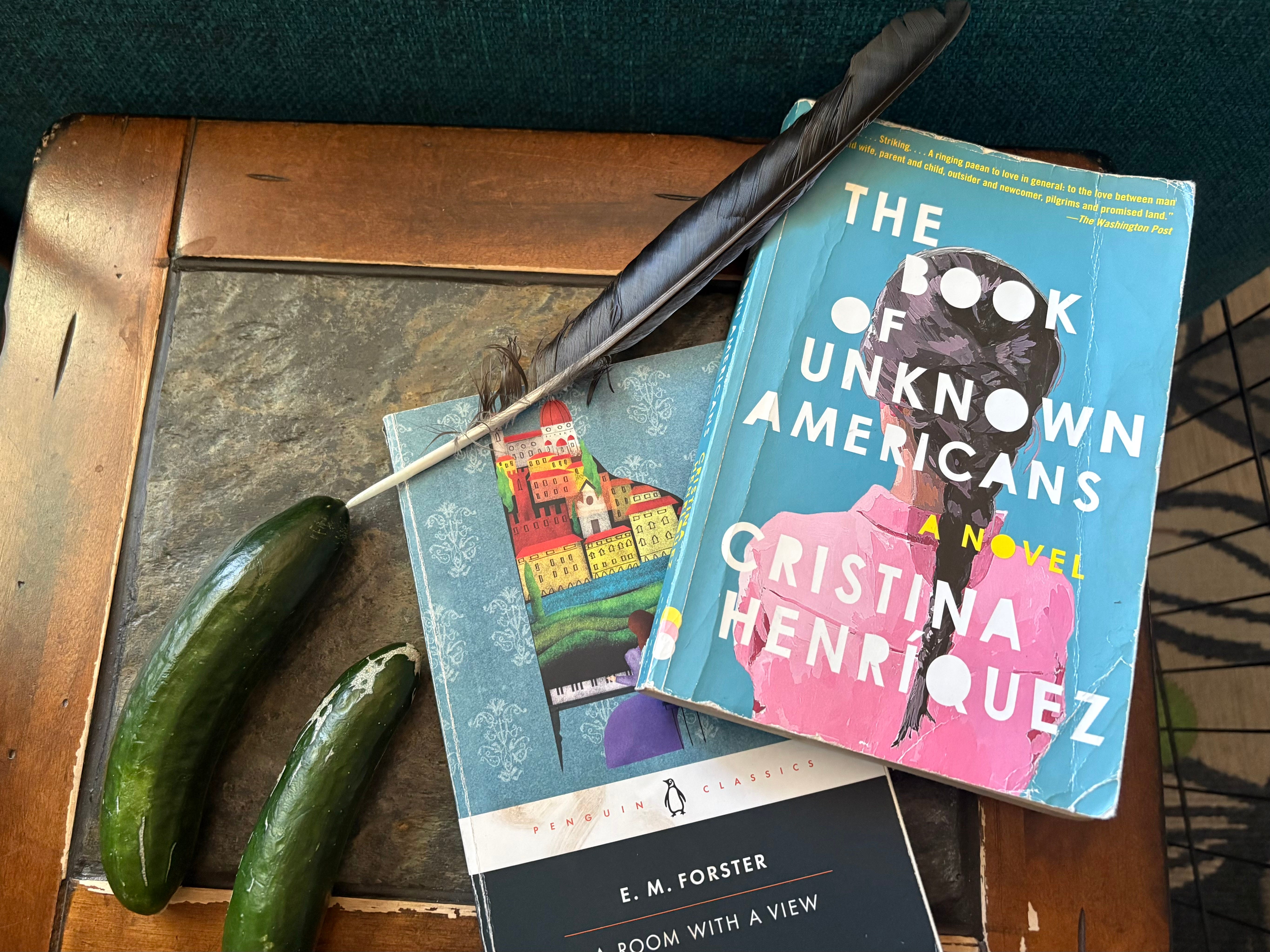
Jake leaned down, picked two cucumbers, and handed them to me. Since I had no backpack or bag for carrying the cukes, I almost refused. Fighting my automatic tendency to reject all offers and gifts, I accepted.
“Thank you!” I said as I followed him back out onto the street.
We parted ways - me to continue my walk and him to ferry more loads of bark to dress the garden paths. At the corner, I took off my sweatshirt, stuffed the cucumbers in the arms, and tied it around my waist, the cucumbers pressing into my sides like a square belt.
As I stood there on the corner, a neighbor, Don, waved as he passed me in his big white pickup. Behind me, I could hear the truck tires rough up the gravel as he parked in front of Jake’s fence.
Don shouted at Jake, “Just stopped by to watch you work.”
They both laughed. I turned back to look as Don slid a shovel from his truck bed. He started scooping bark and heaving it into the wheelbarrow side by side with Jake, the rhythmic scraping of the blades on the dirt counterpoint to their banter.
Crossing the street into denser housing, I chose the shady side. Yards bloomed in the morning light. The quiet and cool from the night before lingered.
A Little Free Library beckoned from under an apple tree in a front yard. I slowed, admiring the library’s rough wood exterior and paned windows, which offered me a peek at the book spines inside.
I thought, I’ll just look, but only take a book if it’s something I’ve been wanting to read. For animal lovers, this is like going to the Humane Society “just to look around.” Inevitably, you go home with a 3-legged dog.
I unlatched the tiny door and peered inside. E.M. Forster’s A Room with a View caught my eye. I picked it up. Set it down. My Dad’s wife did her thesis on the author, and, curious about what drew her to his writing, I’d always wanted to read his work.
But who had the time? Certainly not me. I shook my head side to side.
Then an unfamiliar book title caught my eye: The Book of Unknown Americans by Cristina Henríquez. I pulled it from the case and studied the front: the title in white print over an illustration of the back of someone’s head, a shiny black braid, a plumb-line on a pink blouse. I flipped it over to the back cover to read the description. Then sighed and moved my hand to set it back on the shelf.
I hesitated, questioning my decision to put the books back. Vato, tired of my indecision, lay down on the still-cool sidewalk.
I wanted both books. What was this compulsion to deny that? I paused, breathed deeply, and again said yes, taking them both. I shut the library window quickly before I could change my mind.
A few blocks later at an intersection, I pushed the pedestrian signal button and crossed the boulevard, books in one hand, dog leash in the other, and the cucumbers secured in the sleeves of my sweatshirt. In this area of town, historic trees shelter the turreted and gabled houses that preside over ample lawns. It’s always ten degrees cooler than any other area of the city. The well-watered lawns were too much for Vato to resist. He padded onto one, sniffed the damp grass, and turned in a circle to lie down with a sigh. This was his favorite kind of walking – not walking.
So, while he groaned with pleasure, I spent 5 minutes enjoying the sight of robins wrestling earthworms from the ground.
As I feared, the morning began to warm quickly. So, I encouraged Vato to his feet by luring him with a dog treat. We ambled under the maples and the oaks back toward home.
On our way back, in front of a church, a blue-black crow feather stood out against the bright grass. I collect crow and raven feathers. I took a step toward it, then turned back, leaving it. Then another pause and deep breath. Out loud, I said, “Okay,” (which is pretty close to “yes,” although Year of Okay would not make such a great book title). Then I tiptoed through the damp grass, my toes getting soaked through my canvas shoes, picked up the feather, smoothed out its tangles, and put it in the waistband of my sweats.
When I got home, I arranged my found objects on an end table: 2 cucumbers, 2 books, and a feather, all of which I had initially rejected. But why?
I suspect part of it is an old habit: a fear of being needy. If I don’t accept gifts or need anything, then I owe nothing to anybody. I am a product of the 60s and 70s. I grew up thinking having needs was a character flaw. I understood stoicism as the antidote. So, I learned to turn down offers of food or drink at hosts’ homes, put off using a bathroom, and to say “no, thank you” to any offer.
If I absolutely needed help, I prefaced requests with “Would it be possible?” Not wanting to burden anyone, I ended the request with “If you can’t do it, that’s fine. I have other resources.”
In her powerful essay, ‘The Myth of Too-Muchness, Gina Luker describes this shrinking of women’s authentic selves in order to make other people comfortable. She writes:
“Because the patriarchy did not simply steal opportunities from me. It stole my essence. It stole my personality, my joy, my intuition, and my voice. It convinced me that the careful, quiet, edited version of myself was maturity. It made me believe that being palatable was proof that I had finally gotten myself under control.”
I know I’m not alone in rejecting what delights me. Women are socialized to say yes to taking care of others, to put their own desires and needs last. In the 1970s, when I was a teen, women rose to demand equal rights, an end to domestic violence, and equal pay. Those who wished women would continue to be subservient, primarily men, trotted out the labels “strident” and “needy” as a ploy to shame into silence the call for emancipation.
And so here I am, having resisted my habit of denying my own delight, carrying a bounty of found objects. And in that, I am, in a sense, defying the patriarchy.
Ohhhh … E.M. Forster! May you savor it, Cris, as you savored this day.
Fantastic! Love the last line and chuckled about four times prior to it.